A curmudgeon. A doubter. A “hater” if you will.
The classic “here we go again”, the “talk to me when … “, and finally “I just don’t like *insert person/team/action HERE*”.
In today’s world, it’s easy to fill the page with less than dynamic duos that would fit these descriptions – within athletics or otherwise. Skip Bayless vs. LeBron James, Donald J. Trump vs. Climate Scientists …
Philip John Fleck vs. the Minnesota public.
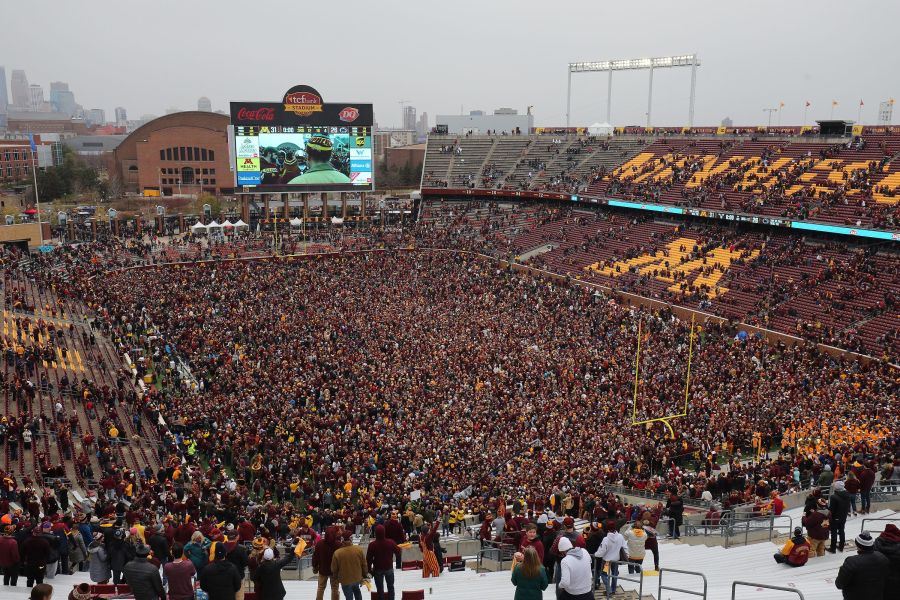
With the Golden Gophers sitting at 9-0, ranked #8 in the country, and PJ Fleck inking a 7yr, $33.25mm extension – it’s easy to forget where we were just over one year ago. On November 3rd, 2018 PJ Fleck and the Gophers were sitting at 4-5 – having just completed a disappointing loss to an Illinois team trudging their way through an equally disappointing season. Despite a 3-0 start – highlighted by a thrilling 21-14 victory to then #18 Fresno State – the Gophers had fallen back to earth. The offense, while potent at times, lacked consistency. The defense had collapsed in blowout losses not once, not twice, but three times culminating in the firing of Defensive Coordinator Robb Smith following the embarrassing loss at Illinois. Yes, at this time PJ Fleck had plenty of curmudgeons, doubters, and “haters”.
I should know – I was one of them.
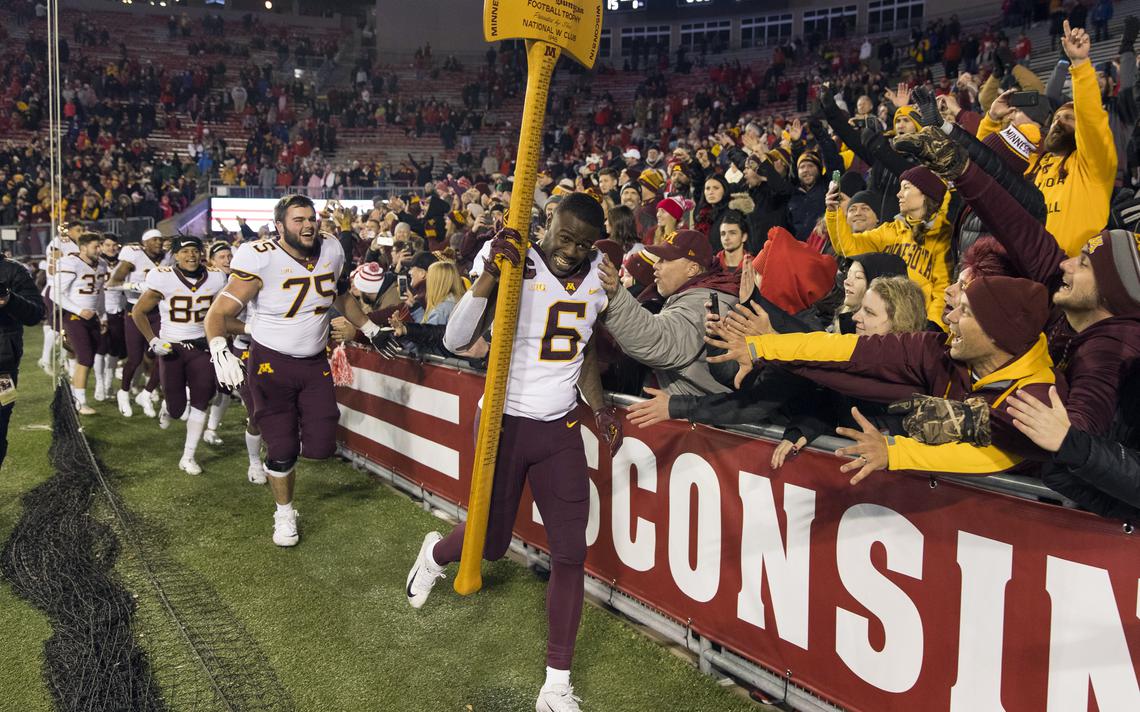
There has been plenty written about the turning point in PJ Fleck’s tenure – the firing of Robb Smith, the elevation of Joe Rossi (and subsequently the defense), and an excellent finish to the 2018 season which peaked with a victory at Wisconsin – claiming Paul Bunyan’s Axe for the first time since the 2003 season.
A different discussion – and one I have not seen written about – is how we got here. What took so long for Minnesotans to “grab an oar”? Why does PJ inspire such a divide amongst fans? How did a 2nd year college football coach, with a track record of success, have many calling for his firing with a win/loss record of 4-5?
To answer these questions. we must not only understand what PJ Fleck brought to the table, but also what preceded it. Opinions are formed on context – what we know, what we don’t, and what we’re afraid of. Opinions are riddled with bias, and the people forming these opinions are no different. To understand why many called for Fleck’s head just 19 games into his tenure, we must examine the influential biases that helped drive that conclusion.
The Peak-End Rule
The Peak-End rule suggests that we judge our experiences based on how they were at their peak (positive, negative, etc.) and how they ended vs. the average feeling throughout the experience. It’s easy to see how this bias can be applied to sport – where it becomes easy to live and die with every snap, pass, pitch, shot, etc.
In terms of Gopher football, this rule can be applied to the four separate coaching tenures that preceded PJ Fleck, and in turn explain fan sentiment entering the Fleck era.
Glen Mason – Coaching Record: 64-57 Bowl Record: 3-4
The Peak: defeating #2 Penn State at Penn State in 1999.
The End: The largest blown lead in CFB Bowl History – Texas Tech Red Raiders erase a 38-7 deficit in the late 3rd Quarter to beat Minnesota 44-41. Coach Mason is fired two days later.

The Legacy: While Gopher fans didn’t know it then, the Mason Era would represent a measuring stick all future teams would look to replicate. Mason took over a woebegone team in 1997 – one that had missed out a bowl for seven straight seasons, and built the program to a level of sustained success, including consistent bowl game appearances, occasional ranked seasons, and occasional trophy game success. So why was he fired? One could point to his 3-15 record vs. Wisconsin and Michigan, the 32-48 conference record – or perhaps his team’s propensity to falter in big games against ranked opponents (many examples – none bigger than vs. Michigan in 2003). More than anything, Mason was a victim of his own success. He pulled a consistent doormat into a 6/7 win team that would occasionally break through to a 9/10 win team. The problem with that level of consistency is that fans will always want more, and consistent high-level success is difficult to maintain in college football. Ultimately, this led to the ouster of the most successful Gopher coach since Murray Warmath.
Tim Brewster – Coaching Record: 15-30 Bowl Record: 0-2
The Peak: Losing to non-major South Dakota at TCF Bank Stadium. Remember – the peak is either the emotional high OR low, and it helps drive how we recall the experience. Most will remember Coach Brew for this game – (or this song – your choice: https://www.reverbnation.com/stpaulslim/song/3613981-play4brew)
The End: While Brewster was fired after falling to 1-6 in this 4th season following a loss to Purdue, he was essentially a dead man walking following the South Dakota loss – with the 7-1 start to the 2008 season a distant memory.
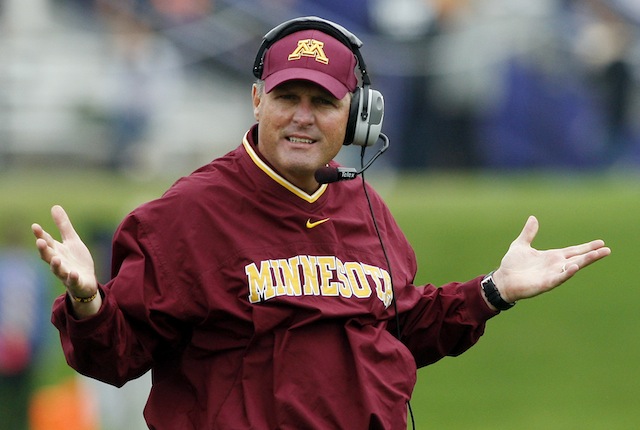
The Legacy: Be careful what you wish for. Following sustained success under Glen Mason, Brewster promised to bring the school levels unseen since 1962 – promising a Rose Bowl in his introductory press conference. What ensued was an endless array of catch phrases, sales pitches, and above all – a lack of success. Brewster finished 0-10 in rivalry games, 0-2 in bowl appearances, and sunk the Gopher Football program into a basement unseen since the Jim Wacker days.
Perhaps more importantly, Coach Brew’s larger-than-life personality mixed with empty promises, grandiose statements, and an overall lack of winning nailed home the perception to Minnesotans that the “used car salesman”-esque coach would always be a fraud.
Jerry Kill – Coaching Record: 29-29 Bowl Record: 0-3
The Peak: New Year’s Day bowl game appearance in 2015, losing 33-17 to the Missouri Tigers. Despite the loss, this was the Gopher’s first January bowl appearance since 1962 (Rose Bowl).
The End: Unlike Brewster and Mason, Coach Kill’s end was not performance related. Instead, the Kill era ended during an emotional press conference October 28th, 2015 – where he retired due to health concerns (epilepsy).

The Legacy:
Coach Kill will always hold a special place in my heart, as he guided the Gophers to back to back 8-win seasons during my freshman/sophomore years at the U. More broadly, he helped bring the Gophers back to respectability following the Brewster years, and molded a program Minnesotans could be proud of. Off the field, he was in stark contrast to his predecessor. No one would mistake Coach Kill for a salesman – and to many jaded Gopher fans, that was a good thing. He had no ego, always interacted very well with the fans, and many were inspired by his off-the-field charity work raising awareness for those suffering from epilepsy along with Coach Kill’s Cancer Fund. Like the Mason years, Gopher fans would come to view Kill’s tenure as a template for success at Minnesota.
Tracy Claeys – Coaching Record: 11-8 Bowl Record: 2-0
The Peak: Defeats Washington State in the Holiday Bowl, guiding Minnesota to its first 9 win season since 2003. In the minds of his detractors, the support to his football team during the December 2016 boycott.
The End: Coach Claeys tweets in support of the Gopher Football team’s boycott stemming from a university sexual assault investigation that ultimately suspended 10 Gopher football players. Following the bowl game victory – and a release of the sexual assault report – Claeys is fired.
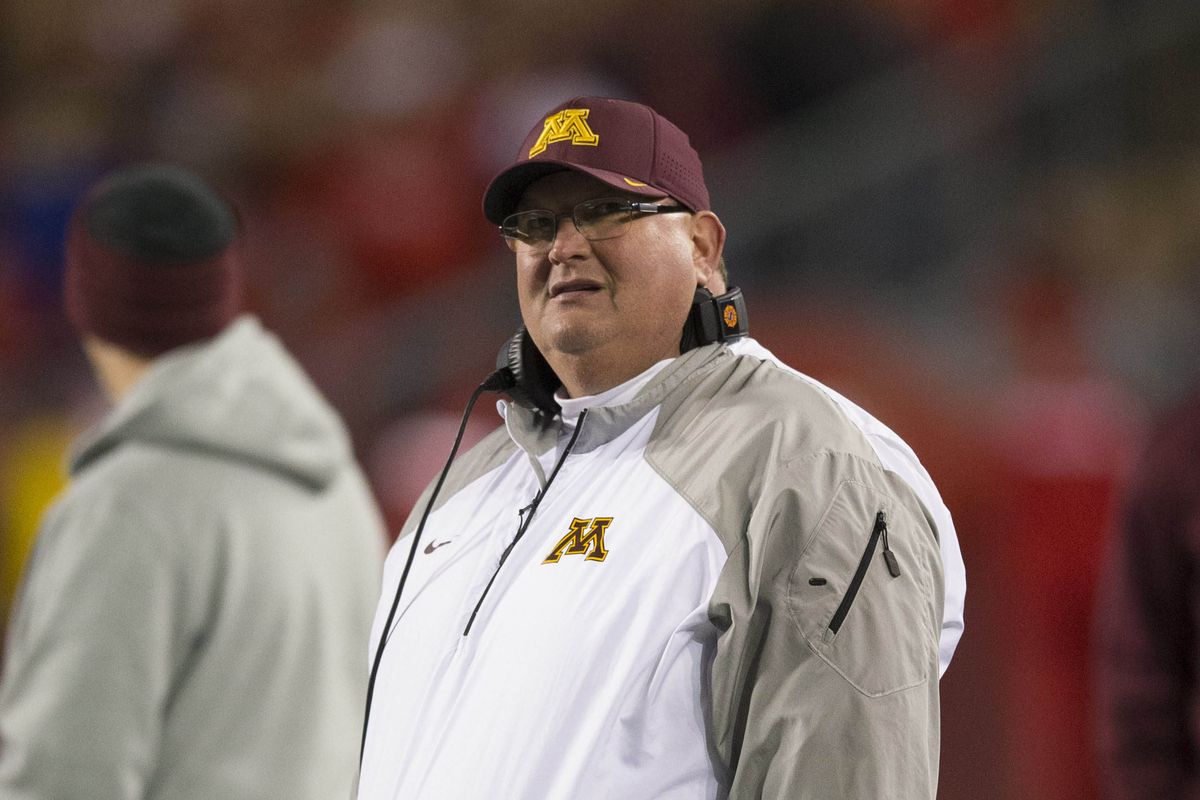
The Legacy: In the simplest terms, Coach Claeys left an incredibly complicated – if not messy – legacy. On one hand, he continued to build upon the successful foundation laid by Coach Kill, and retained much of the same staff. Furthermore, Coach Claeys led the Gophers to the most successful season (at least in terms of wins/losses) in nearly 15 years. On the other, his support of the ill-fated boycott proved to be a massive stain on the Gopher Football program, and one he ultimately could not overcome.
It’s important to note that the ouster of Coach Claeys had a widespread effect – impacting not only his own legacy, but that of Coach Kill. Where there was once widespread appreciation for Kill/Claeys building the program brick by brick, there was now strife amongst the fanbase on how the end was handled.
Coach Claeys was left with a terrible choice – support his football team, or support the administration, which would result in a loss of credibility amongst his players. Before any decision was made, he’d already lost.
How the Peak-End Rule Affected Coach Fleck
The four coaching tenures that preceded the Fleck era can be summarized with the following widespread conclusions:
- Mason: The peak as the baseline for success – beat the Illinois/Northwestern/Purdue/Michigan State tier of the Big 10, and win the occasional rivalry game.
- Brewster: Salesman = fraud. Promised success with endless array of catch phrases, delivered nothing of substance. The peak in this case is an indictment on his coaching style (loud, catch-phrase heavy, salesman-esque) vs. his lack of coaching ability.
- Kill: Rebuilt the program. Soft spoken, lack of an ego, someone that helped jaded Gopher fans get over the Brewster era.
- Claeys: Viewed in conjunction with the Kill era. Importantly, fans that were slow to warm to Fleck and often referenced the 9-win season Claeys delivered prior to his ouster.
So enter PJ Fleck to the hearts and minds of Gopher Nation in the spring of 2017. Here’s a guy who
- Is catch-phrase-heavy (ELITE, THE BALL IS THE PROGRAM, RACE TO “MAH”-turity, etc.)
- Came toting his own personal “Row the Boat” brand (to many Minnesotans upset with the Claeys firing, this was perceived as disrespectful to a school of Minnesota’s stature, and subsequently viewed as egotistical)
- Is following a season that by all accounts was a successful one (unlike Jerry Kill following Brewster’s dumpster-fire).

The Brewster comparisons are apparent, and it gave doubters an easy alley for criticism at the first signs of adversity. Enter season one (or zero, if you’re inclined to buy into Fleck’s view on things) – one that saw Fleck go 5-7 and sees Minnesota miss a Bowl Game for the first time since the 2011 season – it’s easy to see how Gopher Nation can transition into Pitchfork Nation. The events that led to the pressure-filled 2018 season are a culmination of what happened before Fleck, and are entirely out of his control.
Thankfully winning cures all ills – and in the case of the curmudgeonly Gopher faithful, brings out a walkway in which to board PJ’s boat. There is not one way to succeed in this market – and while I’m thankful for the triumphs wrought during the Mason/Kill/Claeys years – we do not need to view these years as the template or ceiling with which to hold ourselves.
A short list of accomplishments for PJ Fleck not attained during the aforementioned era:
- Beaten Wisconsin at Camp Randall (Mason – two wins in MN, Kill/Claeys zero)
- 11 game win streak – longest since 1939-1942
- Achieved a Top 10 Ranking (AP / Coaches / CFP or otherwise)
The reality is PJ Fleck is changing Minnesota’s best. The program is reaching for heights previously unthinkable – and that’s a good thing. While in the past we may have hoped to beat the mid-tier Big 10 teams, hope for the occasional trophy win, and become bowl eligible – we’re now in a place where it isn’t insane to dare to dream of a National Championship.
The Future, and the Survivor Bias:
The Peak-End theory allows events/tenures to be defined by their most notable successes or failures. But what about that success? How do we contextualize success? What attributes make a successful head football coach at the collegiate level?
Immediately, thoughts tend to turn to the Nick Sabans, Dabo Swinneys, or even James Franklins of the world. Yes, these are the coaches who have success. These are whom all rebuilding programs should look to emulate and hope for even a fraction of their success.
Or should they?
The survivor bias is the logical error of concentrating on the people or things that made it past some selection process and overlooking those that did not, typically because of their lack of visibility. This bias leads to selection bias – as we tend to overlook other avenues to success thanks to their relative lack of visibility or prominence.
PJ Fleck, as he himself will say, is not for everybody. He does things differently. He does have wacky catch phrases. He sprinkles the word “elite” into average everyday conversations like salt on a wintery Minnesota roads. His energy is at a level so high – it became easy for doubters to assume he can’t be like this all the time … it’s all an act. What we’ve learned in the past couple years is this:
It’s not an act, it’s a culture
It’s not for you – it’s for the players.
It works.
At 9-0 for the first time since 1904, Fleck likely has a lot less doubters than he did a year ago. With their breathtaking win vs. #4 Penn State at home, the Gophers have garnered the nation’s attention for the first time since the early 1960s. More importantly, Fleck has Gophers everywhere dreaming of a higher bar for success – not only higher than the Kill/Claeys era – or higher than the Mason era – but of heights not reached in generations. One aspect I’ve really come to appreciate from Fleck is his uncanny ability to understand what everyone is thinking. Despite living in Minnesota for less than three full years, he seems to have grasped the woeful mentality of Minnesotans and their sports teams – the constant collapses under pressure, the heartbreaking losses, and the absurd-at-times difficulty of “getting over the hump”.
But, as Fleck said during his postgame presser following the massive Penn State win:
We have to let go of all that. 50 years ago, 40 years ago, 30 years ago, 20 years ago, 10 years ago – we have to change at some point – PJ Fleck
And he’s right. It’s okay to believe in this team. It’s okay to dream of higher heights. It’s okay to grab an oar, get in the boat, and start rowing.
Perhaps the question people should be asking is not “Why can’t PJ be more like _____”, but rather “Why aren’t more coaches like PJ Fleck?”
 The Pine Sports